"I like this new pair of glasses so much. That's when I understood the difference — trying on the demo lenses."
— Mr.G, French senior executive, after his consultation at Optical XMeetings Were a Visual Compromise He Had Stopped Questioning
Mr.G had learned to manage. That is perhaps the most honest way to describe it. As a senior executive who travels frequently for business — spending extended periods in Bangkok, Singapore, and across Southeast Asia — he had built a set of small compensations into his professional life that he rarely examined.
His distance vision was a flawless 20/20. The only correction he needed was for near work, where his prescription measured +2.50D — and it was there that the trouble started. His reading glasses gave him sharp focus at 40 cm, but anything beyond 60 cm blurred immediately. In a conference room spanning three meters, that meant taking his glasses off and putting them back on, over and over, every time his attention moved between a document and the far wall.
Looking at his laptop, he needed the reading glasses. Looking up at the screen across the table, he had to take them off. Back and forth, meeting after meeting. It had become more than an inconvenience — it was starting to irritate him.
He also owned a pair of standard progressive lenses — good ones, purchased from a reputable optician in Paris, fitted with care, the prescription accurate. But he had never warmed to them. Their intermediate zone, the band of clarity you'd use for a laptop or a document across a table, was narrow, and he found himself tilting his head up slightly to hunt for the one angle where it would cooperate. None of this seemed unusual. It was simply how things were.
The limitation is a structural one: a standard progressive lens is built to cover the full range of vision — driving, walking, distance — which leaves only a narrow sliver for intermediate, computer-distance work, often no more than a quarter the width of a dedicated reading lens. For anyone who spends hours in front of a laptop or across a conference table, that sliver is rarely enough.
When Demonstration Matters More Than Explanation
At Optical X, we believe demonstration matters more than explanation — people trust what they see through the lens, not what they're told about it.
Mr.G came in to replace a lost spare pair of reading glasses. It was meant to be a quick errand. After a thorough eye examination confirmed his prescription — 20/20 distance, +2.50D for near — the optometrist began asking about his typical working day rather than simply writing a new order for readers. What does a meeting room look like? Where does the screen sit relative to the table? What is he actually looking at most — a laptop, a document, the person across from him, a screen further away?
From there, the optometrist introduced a different idea: a computer progressive lens, also known as an office lens or occupational progressive. Unlike the reading glasses he'd been living in, it wasn't limited to a single fixed distance. Unlike his standard progressives, its intermediate zone — the "computer zone" — was roughly three times wider than a premium general-purpose progressive, built specifically for the range between a document on the table (about 40 cm) and a whiteboard across the room (3–4 meters), with minimal correction reserved for anything farther, since these lenses aren't meant for driving.
Mr.G tried the demo lenses on the spot. The reaction was immediate: "I don't need to take my glasses off to look at the conference screen, and it has a wide computer zone. I love these glasses." He decided to order a new pair right there. With Optical X's in-house lab, it took just three days to have them ready — noticeably faster than the turnaround he was used to in Paris.
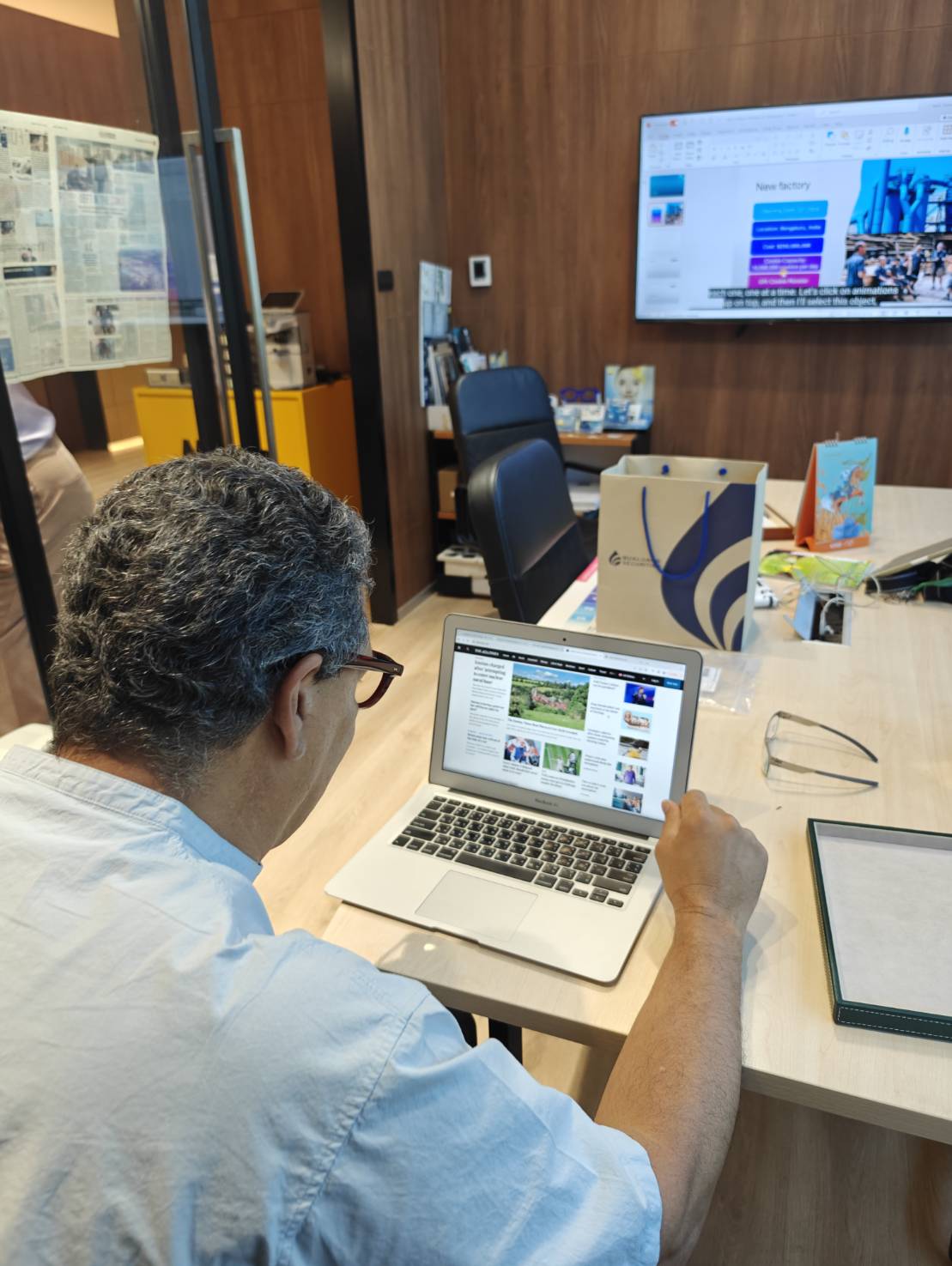
Mr.G at work — the exact back-and-forth between laptop and screen that his reading glasses couldn't cover
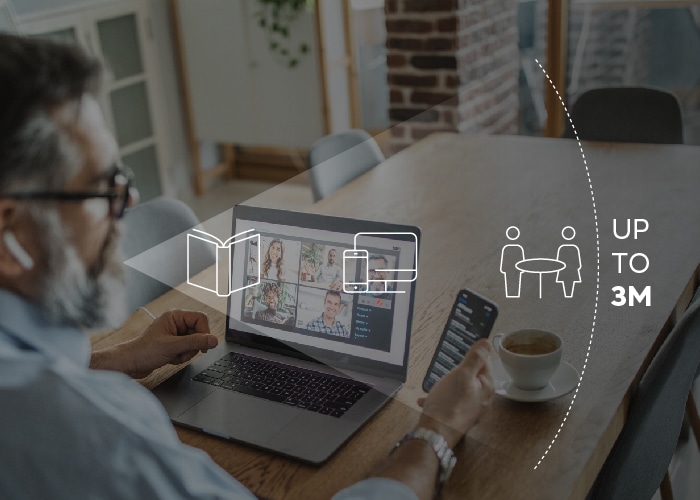
The office lens is built for the zone standard progressives shortchange — table to screen, up to 3 meters
An office lens — also called a computer progressive or occupational progressive — is a specialized lens category designed for professional indoor environments. Unlike standard progressive lenses, which must accommodate the full range from far distance (driving, outdoors) through intermediate (screens, meetings) to near (reading), the office lens concentrates its entire design on the range that matters most in a professional setting: from reading distance (approximately 40 cm) to conference-table distance (up to 4 meters). This focused design allows for an intermediate zone roughly three times wider than a premium general progressive — which translates to comfortable, natural vision across an entire meeting room without the head-tilting and narrow-zone searching that characterizes standard progressives in professional settings. Best paired with a standard progressive or distance pair for outdoor and driving use.
A New Habit Built Around One Airport Stop
Mr.G placed his order before he left Bangkok that trip. The lenses were ready in just three days, and he picked them up the day before his flight back to Europe.

Mr.G picking up his new pair at Optical X, Riverside Plaza Bangkok
His first full week back in Paris included three significant meetings. He didn't remove his glasses to check the screen. He didn't switch between his readers and his old progressives. He simply looked where he needed to look, and saw what was there.
The adaptation to an office lens, for someone transitioning from readers or standard progressives, is minimal — the wider intermediate zone feels natural almost immediately. What takes longer is unlearning the compensations: the small behavioral adjustments that had accumulated invisibly over years of managing lenses that were doing the best they could for a task they weren't designed for.
Mr.G now comes to Optical X on every Bangkok visit. He orders a new pair each time — sometimes the same lens refreshed with an updated prescription, sometimes exploring a new frame. He has described the experience to colleagues in his network, and several have visited specifically when passing through Bangkok on business travel.
"I like this new pair of glasses so much," he said. "That's when I understood the difference — trying on the demo lenses." It was not the explanation that convinced him. It was the experience of trying them on.
The Professional's Case for a Second Pair
If you spend significant hours in meetings — leading presentations, reviewing documents with colleagues, reading across a conference table — your standard progressive lenses may be asking you to accept a compromise that doesn't need to exist.
The office lens is not a replacement for your everyday progressives. It is a dedicated tool for a specific environment, the way a reading light on a bedside table supplements but does not replace the overhead light in the room. Many professionals who understand this keep two pairs: their standard progressives for daily life and travel, and their office lens for the boardroom and the desk.
The best way to understand the difference is the same way Mr.G understood it: not through a diagram or a description, but by trying the lens on and looking through it. At Optical X, we do not assume that your current lenses are wrong — we simply ask what your environment demands, and find the lens that is built for it.
Bangkok offers an unexpected advantage for business travelers who need professional eyewear: world-class lens brands, expert fitting, and pricing that reflects a different economic context than European optical retail. For executives who pass through regularly, it has become a reliable stop.
What Changed for Mr.G
- Whiteboard, laptop, and documents all clear in a single field of vision
- No more compensatory habits — removing his glasses for the screen, switching between readers and progressives, head tilting
- Understood the lens difference through Optical X's demo lenses, not a description
- Now orders a fresh pair every Bangkok visit — a consistent, reliable optician found
- Even mealtimes improved — he can now see his plate clearly without switching glasses