"I come back to Bangkok every year for my eye test. In Germany I pay more and get less explanation."
— Mr.T, a retired German business professional, on why Bangkok became his optician of choiceA Man Who Didn't Know There Was Something Better
The first time Mr.T came to Optical X, he was looking for a pair of reading glasses — his old pair was scratched and had become annoying to use. After the examination, once we knew his prescription, his chief complaint was that he wanted reading glasses he could use for both a computer screen and reading a book at the same time. Like other patients, he was introduced to the Shamir Computer and the Shamir Workspace from Optical X's collection of more than 40 demo lenses. He loved the Shamir Computer glasses since they let him see both distances clearly — book and computer screen — but we also urged him to try the Shamir Workspace, since every customer gets a full demo-lens fitting because each person's needs are different.

Mr.T has excellent distance vision at 20/20; however, for near vision he needs +2.50D. His comfortable reading range is limited to between 30–60 centimeters. Even though he had been wearing reading glasses for more than 20 years, he never liked them much — he was constantly having to find the right focus.
His second complaint is that when he's wearing his reading glasses and looks at the television, everything becomes blurry, which sometimes gave him a headache. We explained that reading glasses are essentially a magnifier — a tool for seeing something small up close, not for seeing far away, since they have no far-distance focus.
So we let him try both: the Shamir Computer, which covers a focus range from 30 cm to 1.5 meters, and the Shamir Workspace, which covers 30 cm to 3 meters but has a narrower computer-screen zone — its far-distance zone is greater than the Shamir Computer's.
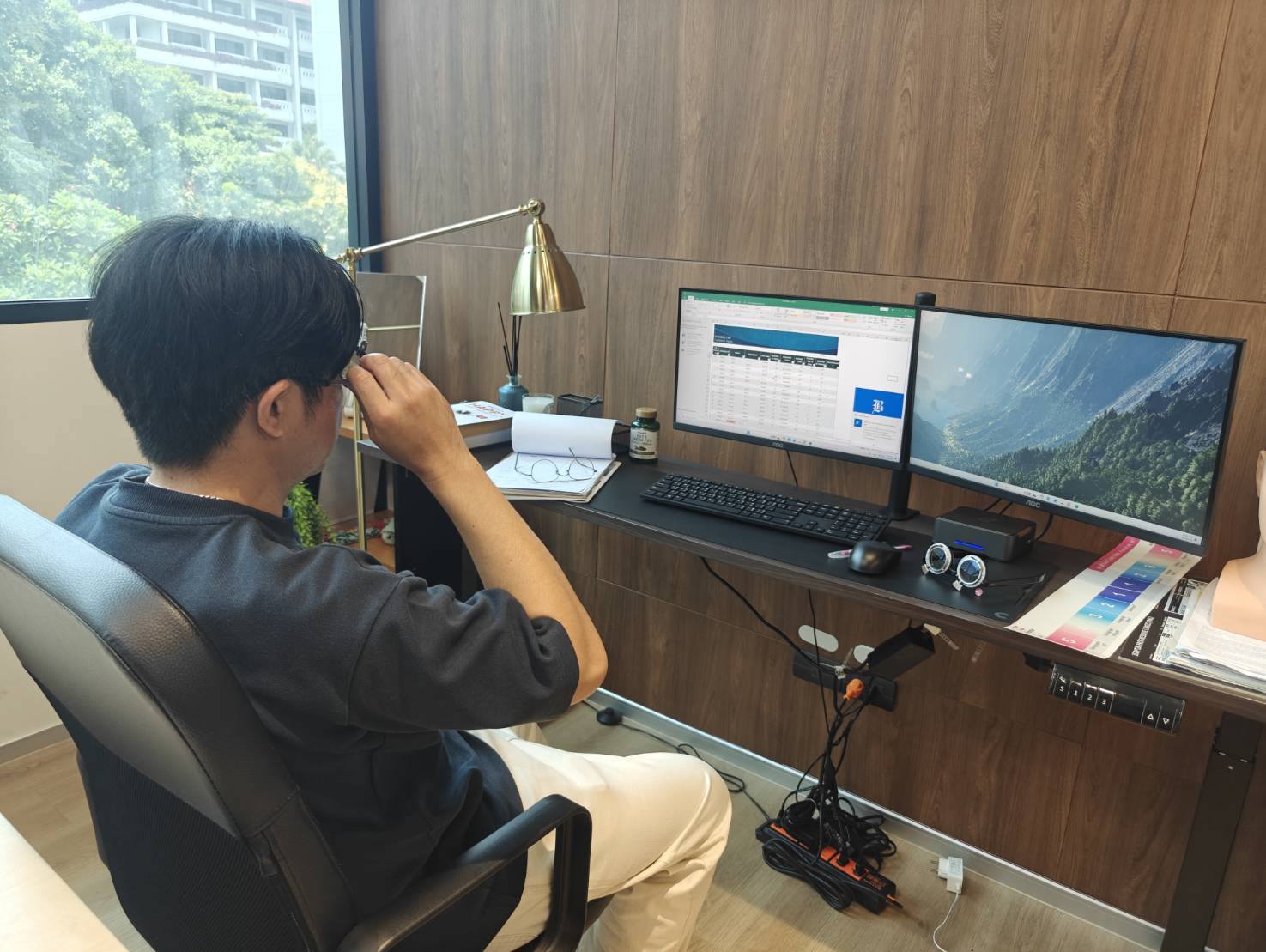
Optical X's simulation zone
He tried both lenses. He liked the Shamir Workspace because it let him see the television more clearly within 3 meters — far better than his reading glasses, and he no longer had to keep taking his glasses off and putting them back on whenever he switched between the computer screen and the television. The Shamir Computer, on the other hand, gave him a wider computer-screen zone, even though its reach toward the television was more limited. Since he switches between his computer screen, reading, and the television — which sits about 2.5 meters away — throughout the day, the Shamir Workspace turned out to be the better answer. As a result, the Shamir Workspace is now his glasses of choice.
To emphasize: if you mainly work across multiple screens, the Shamir Computer is the better choice. In contrast, if you have an office with a television more than 2 meters away — about three arm's lengths — the Shamir Workspace is the answer.
He doesn't wear glasses while walking, thanks to his excellent distance vision — but he uses reading glasses constantly, and found it tiresome to keep taking them off and on.
A Map He Didn't Know He Needed
While Mr.T's frames were being assessed, the optometrist at Optical X conducted a brief conversation about his vision habits. Mr.T mentioned his bifocals in passing. The optometrist asked whether he had ever tried progressive lenses. He had tried them before and didn't like them — no matter how hard he tried to adjust, he could not get used to them, so he switched back to reading glasses instead.
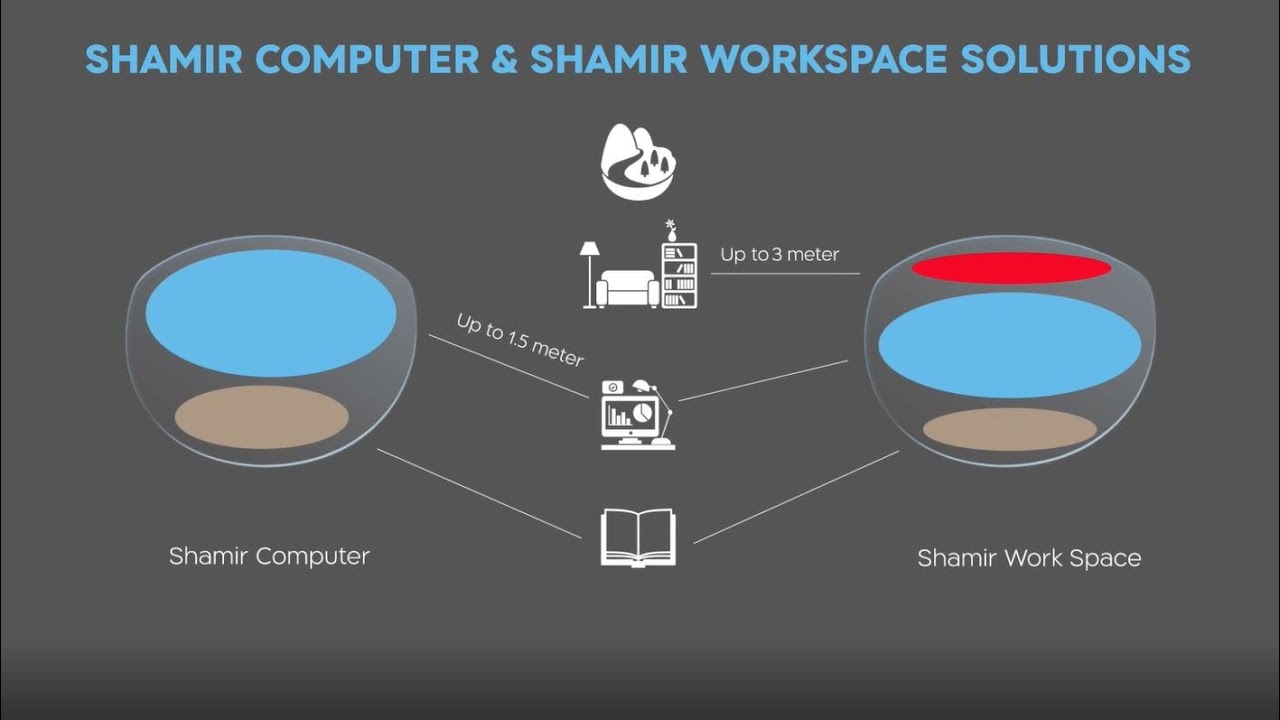
Shamir Computer vs. Shamir Workspace — the two occupational lenses Mr.T tried before choosing
Three Solutions for the Same Need · Different Philosophies. Most people wear the lens type they were first prescribed and never learn that alternatives exist. Here is a clear map of the three categories for presbyopia correction.
"This Is the Glasses That I Want"
Mr.T visits Optical X every year — his travel schedule brought him through regularly, and he had been meaning to pick up a second pair. He came back to Optical X specifically to get a spare one. He told us that these glasses are very important to him — if he lost them, he would be in big trouble. For him, the service, explanation, and price at Optical X had simply become a different experience from what he was used to back in Germany.

The Shamir Workspace — the lens Mr.T now returns to Bangkok for
Optical X customers receive a free regular eye test once they purchase glasses with us.
Mr.T loves how quickly Thailand can deliver glasses. We explained that lens factories such as Essilor, Hoya, Shamir, and Nikon are based in Thailand, since they chose us as their Asia Pacific hub distributor — that's the reason we can deliver to him so fast.
We asked him how long it takes to get a pair of glasses in Germany. He told us it often takes around two weeks. Some lenses here are cheaper than in Germany.
Lastly, from Optical X's point of view, glasses and lenses can sometimes be difficult to explain, because it's like physics (optics) 101 — and when too many technical terms are used, customers can get frustrated because they don't understand what the optician or optometrist is trying to explain. We solve this by providing as many demo lenses as possible. The vision will speak for itself. We at Optical X always believe that customers should choose and design their own vision, which is why demo lenses — both progressive and office demo lenses — are so important.
The Value of Knowing Your Options
Progressive lenses could be the best option if you need to use every distance at the same time; however, if you need to use a computer screen a lot, office lenses are more suitable. This technology has been around for more than 30 years, yet customers still don't know that this product exists.

The Shamir Computer — the tighter-range option for readers whose day is mostly multiple screens, not a television across the room
Mr.T's story is not unusual in its basic shape. Many people wear the lens type they were first prescribed and never revisit the question. Progressive wearers often don't know that office lenses exist as a specialized tool for professional environments. They have to work with a narrow intermediate zone.
The lens category you are wearing may be exactly right for you — or it may be a default choice that was never examined against your actual needs. The only way to know is to have a conversation where the right questions are asked.
For business travelers and expats spending time in Bangkok, Optical X offers an additional practical advantage. The lens brands available here — Zeiss, Hoya, Shamir, Nikon — are the same brands available in European and American optical shops. The clinical expertise is equivalent. The prices are not. For someone who needs new glasses regularly and passes through Bangkok with any frequency, the combination of quality, service, and value is difficult to replicate elsewhere.
A consultation at Optical X begins with a proper eye examination and ends with a clear understanding of which lens, from which category, best matches how you actually live and work. That understanding is not an upsell. It is simply what a good consultation looks like.
What Changed for Mr.T
- Discovered office lenses after fifteen years on regular reading glasses — immediately noticed the difference
- Fitted with an office lens matched to his specific work pattern: reading, screen, board meetings (Shamir Workspace)
- Still uses the same glasses strap as before — the only change was upgrading from reading glasses to an office lens, which the team likes to call a "Super" reading lens: a reading lens that performs better than an ordinary pair
Common Questions About Occupational Lenses
For people who spend most of the day at a screen, an occupational (office) lens such as the Shamir Computer can outperform a standard progressive. It dedicates its full width to the 30 cm–1.5 m intermediate/near range instead of splitting the lens into distance, intermediate, and near zones, giving a wider, more comfortable field for screens and reading. The trade-off is that it has no far-distance zone, so it isn't a replacement for driving or general wear.
A standard progressive splits the lens into three zones — distance, intermediate, and near — so each zone is narrower. An occupational lens drops the far-distance zone entirely and gives that space to the intermediate and near zones instead, which is why it feels noticeably wider for indoor, close-range work.
At Optical X, both the Shamir Computer and the Shamir Workspace start from ฿7,200 — they're priced the same and differ only in design (focus range), not cost. That's significantly below equivalent lens brands in Europe, which is part of why patients like Mr.T now buy all their glasses in Bangkok rather than at home.