
"Getting my glasses made at Optical X was a completely new experience — nothing like buying glasses anywhere else I've been."
— Trent, DenmarkHeadaches Nobody Could Explain
Trent has worn glasses most of his adult life. As a medical professional, he is no stranger to precision — he works in a field where measurements matter and where the difference between close and exact is everything. So when presbyopia set in and his near vision began to blur, the change hit his work hard, and he moved to progressive lenses to compensate.
Two problems followed him from pair to pair. First, his frames were consistently too small, and the arms squeezed against his temples until a dull tightness set in — reliably, within a couple of hours of putting the glasses on. Second, the reading zone on his progressive lenses was narrow, forcing him to tilt his head or shift documents around just to find the small sweet spot where text stayed sharp.
He had tried different brands, acetate and titanium alike, at boutique opticians and department-store chains across Denmark, Germany, and the United Kingdom. Every time, the answer was the same: "You need a size 58." He would try on a few frames in that number, pick the one that looked best, and leave. The tightness always returned.
Trent started to assume this was simply something to live with — a minor cost of wearing glasses that no optician had ever addressed. It never occurred to him that the glasses themselves might be fundamentally wrong — not in lens quality, not in prescription, but in something as basic as how the frame physically gripped his head.
The Measurement That Changed Everything
Trent was staying at the Anantara hotel, one minute's walk from Optical X, when he passed the shop and asked, almost as an afterthought, whether new glasses could be ready within his three-day stay. We told him yes, walked him through the process, and started with a proper assessment of what he actually needed rather than what he thought he needed.
Before looking at any frames, the optician reached for a caliper — not a tape measure, not a rough eyeballing, but an actual instrument — and measured the width between Trent's temples at the point where the arms of his glasses would rest. Then came the explanation that, in years of wearing glasses across several countries, nobody had ever given him: the number printed inside a frame — "54," "58," "60" — refers to the horizontal lens width, not to temple span. Two frames carrying the same number can sit at entirely different angles on your head depending on the arm length, the bend, and the temple curvature. Every "size 58" Trent had bought before was the right lens width and the wrong fit.
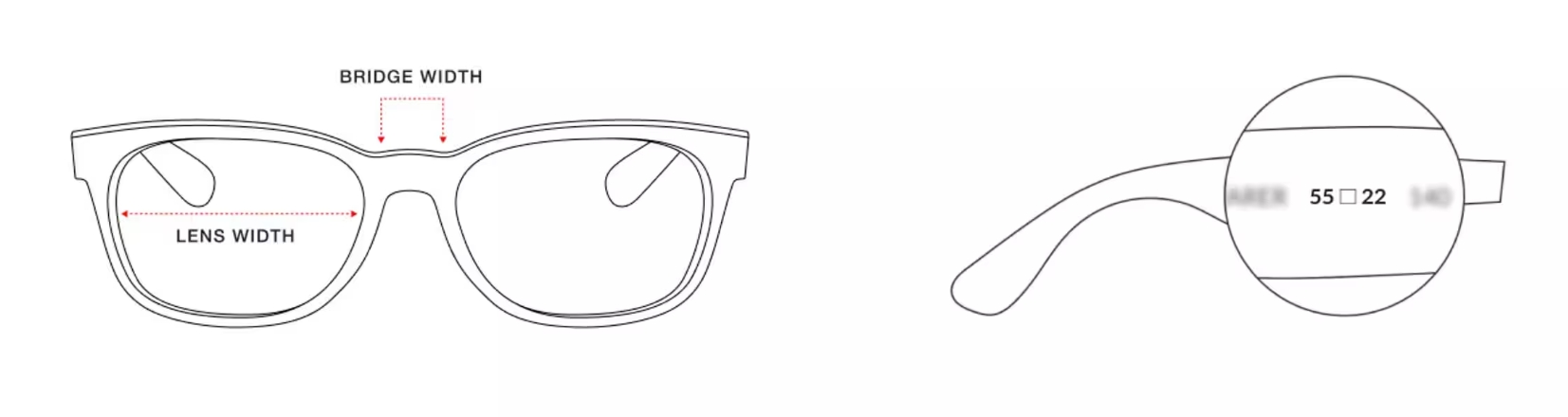
With that measurement as the starting point, the recommendation was a genuinely oversized 58 — a frame engineered to sit across his full temple width without the arms squeezing inward, rather than a standard 58 that merely matched the label. The difference was immediate: no pinching, no clamping, no sense of the frame asserting itself against his head.
The lens conversation came next. Trent wanted a wider near reading zone than his current progressive lenses offered, but he did not want to overspend on the upgrade. Rather than recommend the most expensive option outright, we had him trial demo lenses across the full Autograph line — the A3D, the Intouch, and the Urban — so he could feel the difference against his budget. With the Autograph A3D, he could see across a full A4 page, and he noticed that the pricier lens outperformed the others in every dimension: faster focus, a smoother transition when shifting from far to near and back again, and a wider zone that felt genuinely easier on the eyes. Still, he chose the Autograph Urban — it answered what he needed for now, with the intention of upgrading to the A3D on a future visit. Comparing the Urban side by side with his old glasses, the difference was immediate: the reading zone was roughly 30% wider, letting him read across nearly two columns of a magazine page without moving his head.
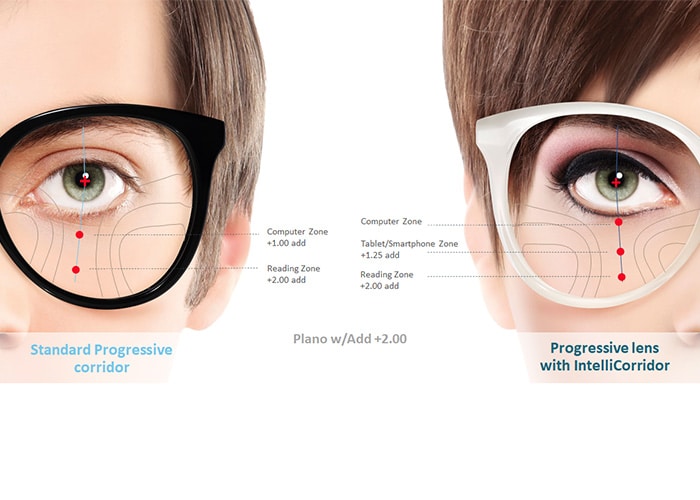


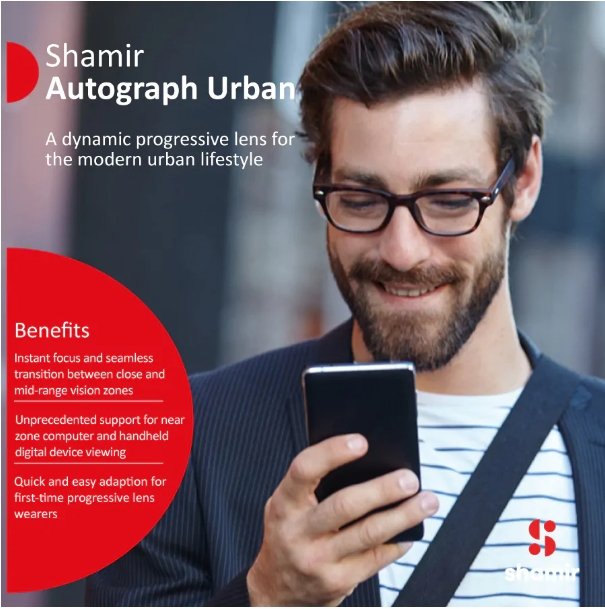
The Shamir Autograph Urban is designed for patients who spend significant time reading, working at a desk, or using screens at close to intermediate distance. Its defining feature is a widened near reading zone — typically around 30% wider than a standard progressive. The soft design minimizes peripheral blur during adaptation, making it well-suited for first-time progressive wearers and experienced wearers who have struggled with narrow reading zones. Patients seeking an even wider near reading zone can step up to the Autograph Intouch or Autograph A3D within the same lens family.
No Headache. Not That Afternoon, Not the Day After.
Trent wore the glasses for the rest of his time in Bangkok and reported back before his flight: no headache, not that afternoon, not the following day. The reading zone in his Shamir Autograph Urban lenses was noticeably wider than anything he had experienced before — he could read roughly two-thirds of an A4 page without moving his head from side to side. Before he left, he confirmed his plan to step up to the Autograph A3D on a future visit, once the upgrade fits his budget.
What struck him most, he said, was not the lens itself but the diagnostic process behind it: the temple measurement, and the explanation of what a frame number actually describes. As someone who works daily with clinical precision, he found it almost perplexing that an industry so dependent on measurement had, in his experience, so consistently skipped this one step. "I have a medical background," he said. "I know what it looks like when someone actually measures versus when they're guessing. This was the first time anyone at an optician actually measured."
If Your Glasses Have Ever Given You a Headache
Temple discomfort from glasses is far more common than most people realize — and far more avoidable. If you have ever had glasses that felt tight after a few hours, or if you have been told to "just adjust to it," it is worth asking whether your frames were ever properly measured for temple width rather than simply assigned a size number. The number on the frame is a starting point, not a fit guarantee. Sometimes the frame that fits your head best is not the one you would have picked for looks alone — and that trade-off is worth making. Proper eyewear fitting accounts for the actual geometry of your head, and that requires a measurement, not a guess.
What Changed for Trent
- Temple pinching eliminated — resolved through proper temple-width measurement, not trial and error
- Learned that frame size numbers describe lens width, not temple fit
- Progressive reading zone widened by roughly 30% — no more head-tilting to find the sweet spot
- Fitted with a frame and lens combination matched to his actual head geometry and budget
- New glasses measured, fitted, and ready within his 3-day stay in Bangkok
Common Questions About Frame Fit & Progressive Lenses
What does the number on my glasses frame actually mean?
The number printed inside a frame (e.g. 54, 58, 60) refers to the horizontal lens width in millimeters — not the distance between your temples. Two frames with the same number can fit completely differently depending on the arm length, bend, and temple curvature, which is why relying on the number alone often leads to a frame that pinches.
Why do my glasses pinch or hurt behind my temples even though the prescription is correct?
Temple pinching is almost always a fitting issue, not a prescription issue. It happens when the frame's temple width is narrower than the actual width of your head at the point where the arms rest. A proper caliper measurement of temple width — not just trying on a few frames in your usual size — is the only reliable way to prevent it.
What is the "near reading zone" in a progressive lens?
The near reading zone is the area of a progressive lens dedicated to near vision, such as reading a document or a phone. Standard progressive lenses have a narrow, single-column reading zone. Premium designs like the Shamir Autograph Urban widen this zone significantly, letting you read across a page without tilting your head or shifting the material.
How long does it take to get progressive glasses made in Bangkok?
At Optical X, standard progressive glasses are typically ready within 3 days, which fits comfortably within most visitors' hotel stays in the Riverside area near Anantara.
Do I need to pay a premium price to get a wide reading zone?
Generally, yes — higher-tier lenses do perform better. A step up, such as from the Autograph Urban to the Autograph A3D, typically delivers a wider field of view and a faster speed of focus, which makes the transition between near and far vision feel noticeably smoother. Sometimes a lower-tier lens can offer a similar reading-zone width, but the speed of focus is usually where the difference is most noticeable. Optical X lets patients trial demo lenses across the full range — the Autograph A3D, Autograph Intouch, and Autograph Urban — so you can feel that difference for yourself and choose the lens that best balances comfort and cost, rather than guessing.
Is the Shamir Autograph Urban good for first-time progressive wearers?
Yes. The Shamir Autograph Urban uses a soft lens design that minimizes peripheral blur during adaptation, which makes it a comfortable entry point for first-time progressive wearers as well as experienced wearers who have struggled with a narrow reading zone in standard designs.